Why We Open-Sourced OpenLoomi AI
Published on 7/5/2026
Your AI work partner shouldn't also be your landlord.
The day we finished building OpenLoomi's core architecture, we sat around and asked ourselves one question: should this be closed-source or open-source?
The answer wasn't hard for us. But the thinking behind it is worth walking through.
Everything You Do With AI Should Be Yours
Every AI tool on the market right now operates on the same model: your data goes in, it trains their harness or model.
Your chat history, your emails, your project decisions, every customer you've talked to — these aren't "inputs." They're raw material. And that material gets fed into systems that shape their future outputs.
You're helping them build a better AI. But you never get that data back.
That's not a conspiracy theory. That's a business model. Free or cheap access in exchange for your data. The bill comes due eventually.
We didn't want to play that game.
OpenLoomi has been local-first from day one. Your data lives on your machine, encrypted, never leaving your device. Nothing goes to our servers. That's not a feature — it's our stance.
But that alone wasn't enough.
Closed-Source Is a Trust Tax
Even if a closed-source tool promises "we don't collect your data," you still have to trust them.
Trust they won't change terms. Trust they won't get acquired, audited, or internally compromised. Trust the next CEO won't decide "user data monetization" is a good idea.
We're not saying those companies are malicious. But trust has an expiration date. And software lifetimes tend to outlast company positions.
Open-source eliminates this problem entirely.
The code is right there. You can audit it. Fork it. Run it yourself. Have anyone verify it. You don't need to trust us — you can verify us.
That's real long-term security. Not a contract clause. Transparency.
What We Built
If you want to know what we actually built, here's the breakdown in five parts.
AI's second brain
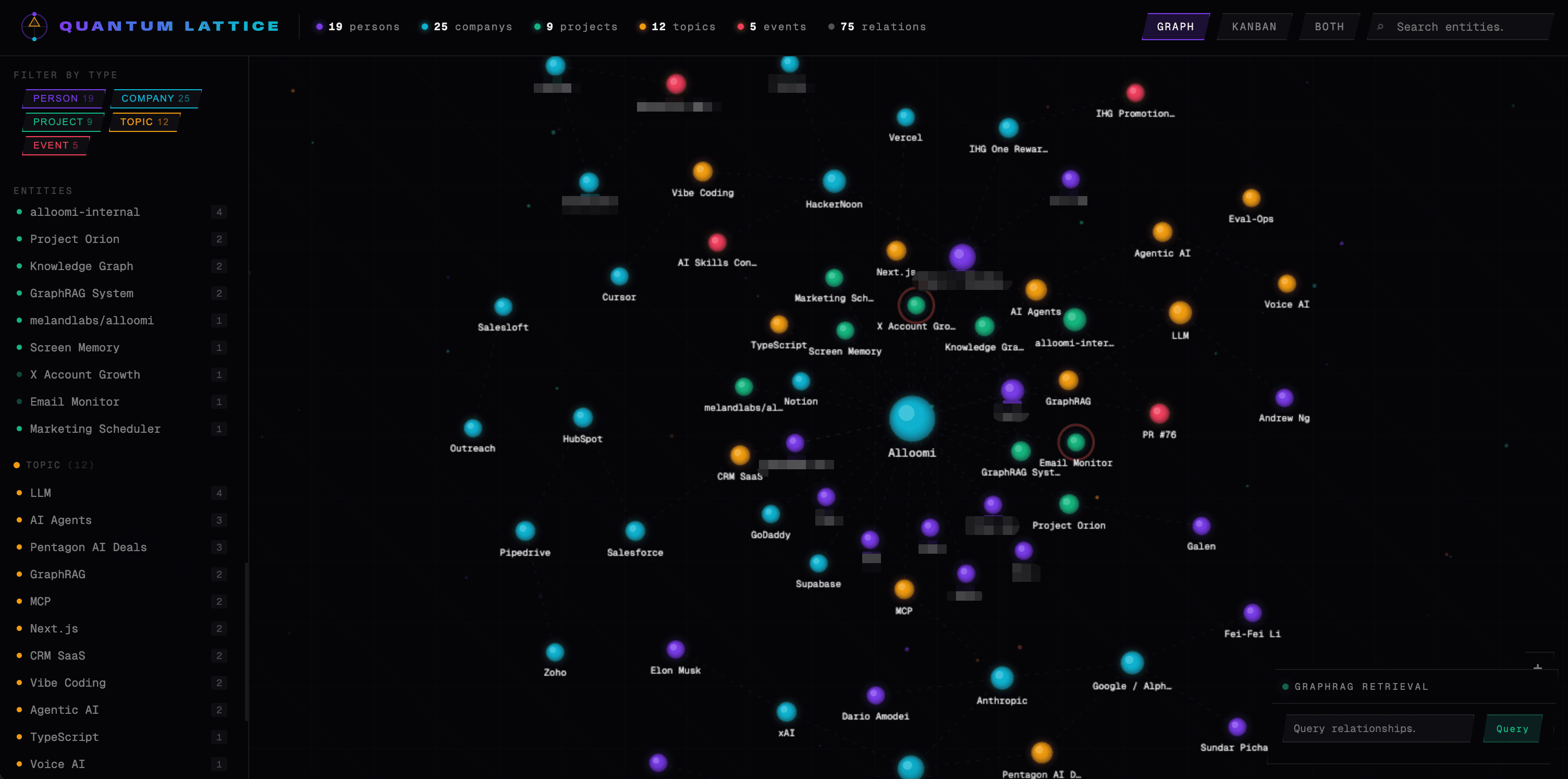
The core of OpenLoomi is a self-evolving memory system. Every conversation with the AI, every email, every project decision — it extracts, scores, prioritizes, and remembers. Frequently accessed information stays sharp; unused stuff gradually sinks and archives. This all happens automatically, no tagging or manual organization required.
Memory layers: raw information → insight extraction → contextual state → knowledge graph. Your AI partner doesn't start from scratch every time you chat — it remembers decisions you made last month, project directions you discussed last week, the thing you tabled yesterday.
N platforms, one inbox
We've connected Telegram, WhatsApp, WeChat, Slack, Discord, QQ, DingTalk, Feishu, iMessage — all major messaging apps covered, and you can use your phone to chat with OpenLoomi and remotely trigger anything you want it to do.
Email via Gmail and Outlook. Calendar via Google Calendar and Outlook Calendar. Documents via Google Docs and Notion.
Project management and CRM via Jira, Asana, Linear, GitHub, and HubSpot. Social via X/Twitter, LinkedIn, and more.
All of this — messages, emails, calendar events, document updates — flows continuously into OpenLoomi. Not just push notifications, but AI-understood, organized context. A built-in background Agent runs every 30 minutes like a diligent warehouse keeper, sorting new information, extracting value, so that by the time you talk to the AI, it's already done its homework.
Automation, on your terms
Cron expressions, interval triggers, one-time triggers — three scheduling modes. Set up "AI news summary every morning at 8," "project weekly report every Friday at 5," "calendar check every 30 minutes with 15-minute advance reminders." Tasks run agent-driven with timeout recovery and full execution history. Change a config, no restart needed — it takes effect immediately.
Local-first, but not local-only
Native desktop apps (macOS / Windows / Linux), data stored locally, AES-256 encryption. Optional: if you want, you can also connect to cloud APIs.
Our commitment: your data will never be used to train any model. This is baked into the architecture, not just the terms of service.
Skills are open — plug into any Agent
Every OpenLoomi capability — memory system, platform connectors, automation engine, document processing — is packaged as a standalone Skill interface. You can integrate these skills into any Agent you prefer: Claude Code, Codex, OpenClaw, Hermes, and more — as long as it supports skills or a similar extension protocol, it can call everything OpenLoomi has.
This isn't a lock-in strategy. It's a choice: The base layer is public infrastructure. The Agent on top is your tool. Which Agent you use is your call. OpenLoomi handles memory and tools in the background.
We're Not Selling Software — We're Building Infrastructure
Honestly, we had a serious closed-source discussion for a while.
The reasons were solid: closed-source is easier to commercialize, easier to control the experience, easier to protect early interests. Almost every successful SaaS took this path.
But we asked ourselves: is OpenLoomi solving a big enough problem?
If you think of AI memory, platform connectors, and automated workflows as an infrastructure layer — one that lets AI truly understand your work, your context, how your team collaborates — then this layer shouldn't be owned by any single company.
This thing is too big to be one company's asset.
It should be public infrastructure.
We open-sourced not to abandon commercial value, but because we believe that when the base is open enough, the possibilities on top are endless. Linux, PostgreSQL, Redis — they all went this way.
We build the base. The ecosystem builds on top.
The Developer Community Is the Real Moat
Honestly, we spent a while worried about who would contribute, maintain, and ensure quality once it was open-source.
The answer surprised us: people who seriously contribute to open-source are usually the same people who seriously use tools.
Building OpenLoomi internally, our biggest pain wasn't missing features — it was realizing you can only imagine so many use cases when you're building something yourself.
But different people, different teams, different industries will use it in completely different ways. Someone's running customer service automation. Someone's building a content pipeline. Someone's doing CRM memory. Someone's running an internal knowledge base — uses we never imagined.
The best features often come from users, not developers.
Open-source opens that possibility up.
Why We Open-Sourced — Three Points
We believe local-first is the right call. The more AI understands your work, the less it should be someone else's tenant. It should be yours.
We believe infrastructure shouldn't be monopolized. An AI system that truly understands your work should be a public layer, not any company's proprietary asset.
We believe open-source makes us better. Not because we get free labor from the community — but because the community will turn OpenLoomi into something we could never have imagined ourselves.
How Far Do You Want to Get Involved?
You can just download, install, use it, and tell us what breaks in your current workflow.
You can get involved — we have good first issue labels, docs, tests, connector adapters, automation logic — plenty of places to start.
Or you can fork it and build your own version. We use Apache 2.0 — no copyleft, commercial-friendly.
OpenLoomi is open-source. The installer is free. The AI is yours.
The rest is up to you.
Check Out the Code
Star the repo, read the source, open issues, or fork it — everything lives there.
Try It Out
Or clone and run it yourself:
git clone https://github.com/melandlabs/openloomi.git
cd openloomi && pnpm install && pnpm tauri:dev
For issues or questions, hit Documents, GitHub Issues or Discord — we're around.